Boxed tote bag pattern
A flat-bottomed market bag with boxed corners. Sewing pattern, 36 × 38 × 10 cm.
Difficulty: 2 out of 5. Easy: more sewing steps.
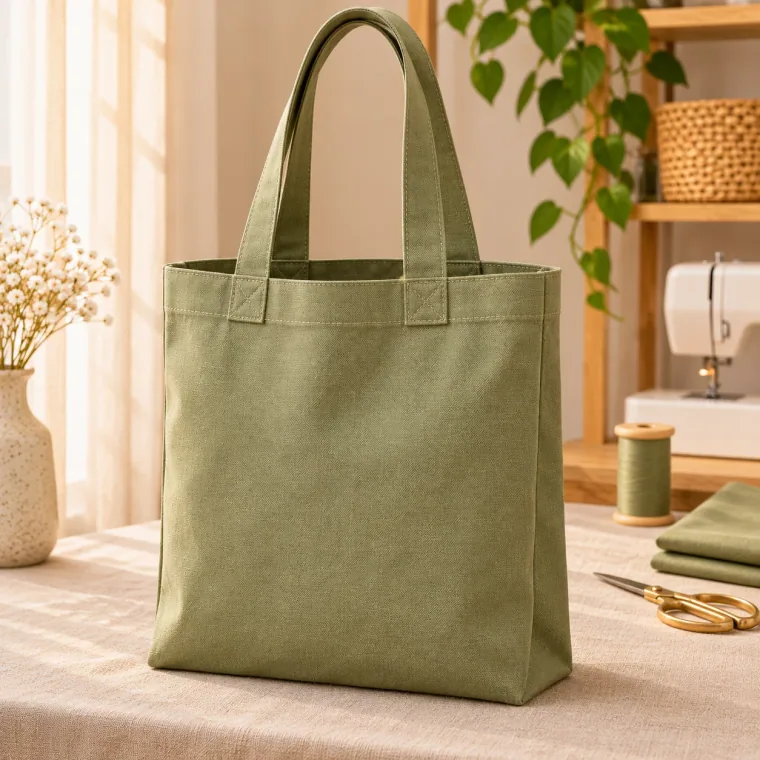
Sizes may vary with the materials you use. We suggest making a small sample first.
- Size
- 36 × 38 × 10 cm
- Seam allowance
- 1 cm
- Fabric
- 65 cm × 140 cm
- Base depth
- 10 cm
- Corner cut
- 5 cm × 5 cm
- Pieces
- 4
You will need
- 65 cm of 140 cm wide fabric
- Matching thread
- Sewing machine with zigzag, or an overlocker
- Fabric scissors or a rotary cutter
- Ruler, tape measure and fabric marker
- Pins or fabric clips
- Iron and ironing board
- Fabric: Sage
Before you start
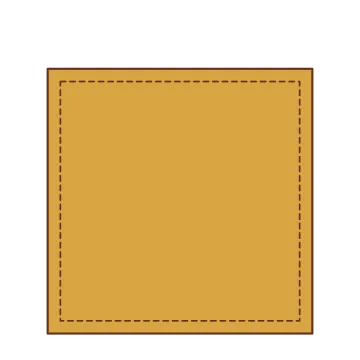
- Print template pages at 100% (actual size) and check the test square before cutting.
- Wash and iron the fabric before cutting, so it shrinks now and not after sewing.
- This is an unlined bag with no pockets. Medium or medium-heavy cotton canvas, duck canvas or a tightly woven cotton works well. Thin fabric may need extra support at the strap ends.
- How much it can carry depends on the fabric, the thread and your stitching, so no weight limit is given.
- Pin the pieces before sewing, and press each seam with an iron as you finish it.
- Start and end each seam with a few stitches backwards so it does not come undone.
- Try your machine on a scrap of the same fabric first.
Abbreviations
| Right side | The side of the fabric that shows on the finished item. |
|---|---|
| Raw edge | A cut edge that has not been folded or finished. |
| Seam allowance | The strip between the cut edge and the stitching line. |
| Topstitch | A straight line of stitching on the right side, close to the edge. |
| Wrong side | The side of the fabric that stays inside the finished item. |
| Backstitch | A few stitches backwards at the start and end of a seam, to secure it. |
| Boxed corner | A sewn corner that gives the bag a flat base. |
Cutting
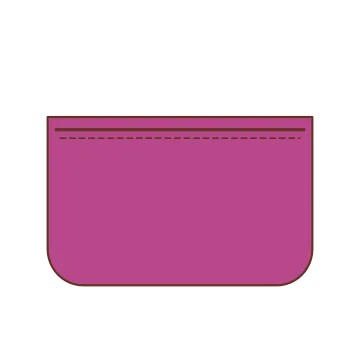
Use the paper template, or cut a 48 cm × 48 cm rectangle and remove a 5 cm × 5 cm square from both bottom corners. Measure the square from the cut corner and add no allowance.
| Main panel × 2 | Use the paper template. Bounding size 48 cm × 48 cm. | |
|---|---|---|
| Strap × 2 | Cut a rectangle 10 cm × 62 cm, allowances included. |
The boxed seam sits 5 cm from where the side and bottom seams meet on each side, so the base comes out 10 cm deep. Both panels have two cut corners.
Make the straps
| 1. | Lay a strap wrong side up, fold it in half lengthwise, press and open it. | |
|---|---|---|
| 2. | Fold both long edges to the centre crease and press. | |
| 3. | Fold along the centre again, so the raw edges are inside, and clip. | |
| 4. | Topstitch both long edges 2 to 3 mm in, with backstitches at each end. | |
| 5. | Repeat for the second strap and check that both match. |
Each strap ends up 2.5 cm wide and 62 cm long. The short ends stay open for now.
Sew the sides and bottom
| 1. | Place the panels right sides together, line up the edges and pin. | |
|---|---|---|
| 2. | Sew both sides with a 1 cm seam, with backstitches. | |
| 3. | Sew the straight bottom edge between the corners with a 1 cm seam. |
Do not sew the cut corners yet.
Box the corners
| 1. | Keep the bag inside out. Open one corner and bring the side seam and bottom seam together. | |
|---|---|---|
| 2. | Lay the two seams exactly on top of each other. The two cut edges now form one straight line. Clip it. | |
| 3. | Sew straight across, 1 cm from the raw edge, with backstitches. | |
| 4. | Repeat on the other corner and check that both seams are the same length. | |
| 5. | Clean the raw edges of the side, bottom and corner seams with zigzag or overlock, without cutting the stitching. |
Each corner seam should measure about 10 cm, giving a base of about 36 cm × 10 cm.
Hem the top edge
Do this with the bag still inside out.
| 1. | Fold the raw top edge in by 1 cm and press. | |
|---|---|---|
| 2. | Fold it in again by 3 cm, press and clip. | |
| 3. | Topstitch all round, 2 to 3 mm from the lower fold. | |
| 4. | Sew a second line all round, close to the top edge. |
You now have a 3 cm band with the raw edge hidden.
Place the straps
Turn the bag right side out and shape the corners with your fingers. The straps go on the outside of the band.
| 1. | Fold each short end of a strap under by 1 cm and press, so the raw end is hidden. | |
|---|---|---|
| 2. | On one side of the bag, mark 9 cm in from each side seam. The outer edge of the strap goes on these marks. | |
| 3. | Lay the strap ends 3 cm down over the band, with the folded end facing the bag, and clip. | |
| 4. | Check that the strap is not twisted, then do the same with the second strap on the other side. |
Both ends of a strap stay on the same side. The strap shows 54 cm between the bag edges.
Stitch the straps
| 1. | At one strap end, sew a small rectangle around the part that overlaps the band. | |
|---|---|---|
| 2. | Sew two diagonals inside it to form an X, with backstitches at the start and end. | |
| 3. | Repeat on the other three strap ends. Go slowly, as the layers are thick here. |
You should have four box and X joins. Do not rely on one straight line of stitching.
Finishing
| 1. | Press the top edge and straighten the side seams. | |
|---|---|---|
| 2. | Stand the bag up and check that the base and the straps are even. | |
| 3. | Trim all the thread ends. |
If something looks off
| • | The base is not 10 cm: check that the corners were cut 5 cm × 5 cm. | |
|---|---|---|
| • | The corners differ: the side and bottom seams were not lined up exactly. | |
| • | The straps are uneven: measure the marks again from the side seams. | |
| • | A strap is twisted: check it along its whole length before stitching. | |
| • | The top edge ripples: press it first and do not stretch it while sewing. | |
| • | Threads come out of the edges: clean the seams with zigzag or overlock. | |
| • | The strap joins look weak: check the box and X. On thin fabric add a patch of the same fabric. | |
| • | The bag will not stand up: the fabric may be soft. A firmer canvas helps. |